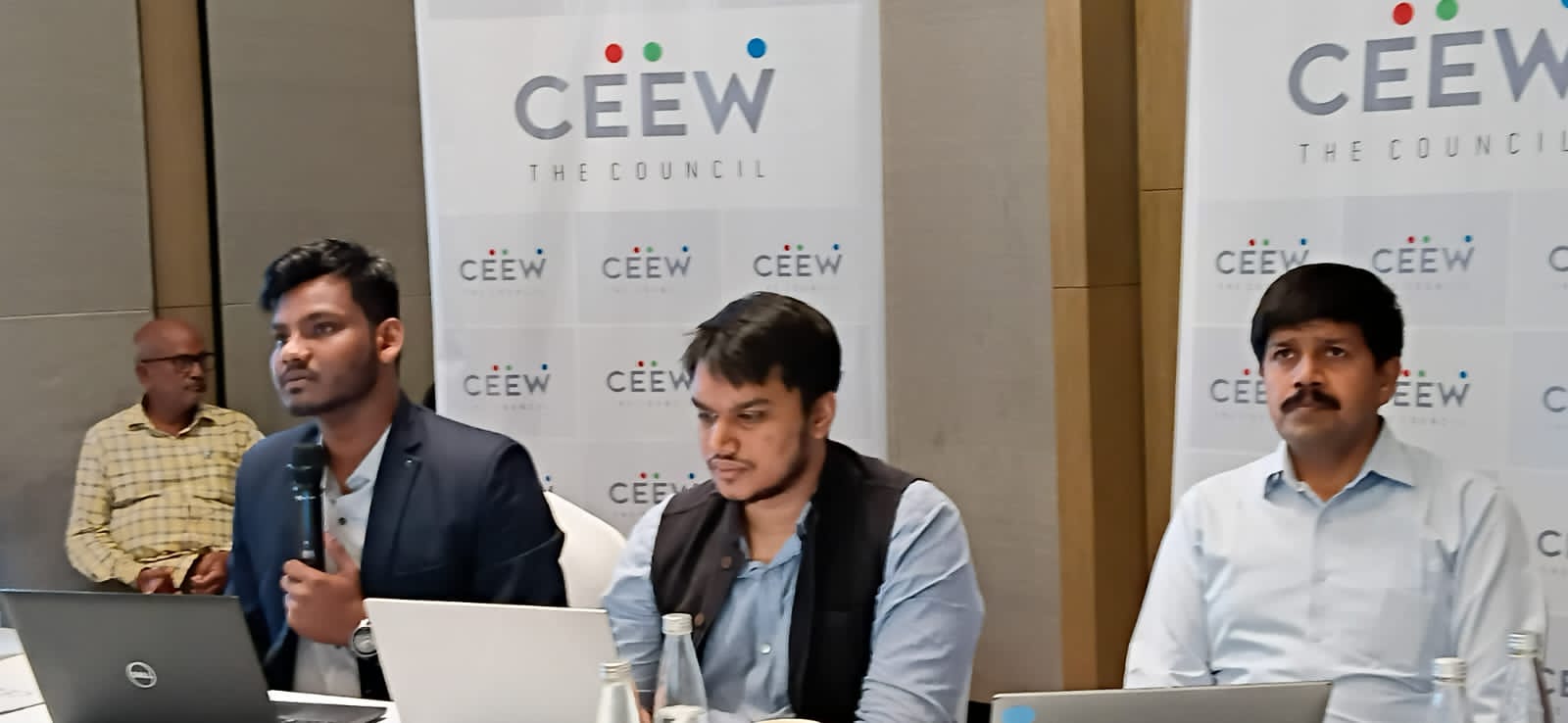
Bhubanaswar: 19 August 2026( pratyusha Bureau ) The Council on Energy, Environment and Water (CEEW) – a homegrowninstitution headquartered in New Delhi and one of the world’s leading climate think tanks – todayhosted a knowledge-sharing roundtable in Bhubaneswar on “Strengthening Climate Resilience throughAl-Driven Climate Decisions and Actions.” CEEW researchers highlighted how India’s 2026 monsoonreflects two contrasting realities. While some states are facing devastating floods, others are strugglingwith severe rainfall deficits, leaving more than half of the country’s districts short on rain.CEEW researchers also demonstrated the Climate Resilience Analytics and Visualisation IntelligenceSystem (cravis.ai), a first-of-its-kind Al-powered climate intelligence platform developed by CEEW.CRAVIS combines over 40 years of historical climate data with projections extending to 2030-2050 and2051-2070. It enables district-level analysis across 279 indicators under multiple emission and globalwarming scenarios. It also allows users to overlay climate data with sectoral datasets-such as India’spower infrastructure, agriculture, land use, and public health information and population for integratedrisk analysis. The platform is designed as a collaborative data commons, inviting organisations andpartners to contribute datasets and analysis to continuously expand and strengthen its intelligence base.Odisha is one of India’s most cyclone and flood-prone states. Its long coastline and strong dependenceon the monsoon make it particularly vulnerable to heavy rainfall, extreme heat-humidity conditions andprolonged dry conditions. According to CRAVIS.ai, these climate risks are likely to become morepronounced in the coming decades, with increasing greater variation in rainfall across districts and heatexposure. In Odisha, average monsoon rainfall increased from 1,052 mm during 1981-2010 to 1,159 mmduring 2011-2024. It is projected to moderately increase to 1,211 mm by 2031-2050 and further to1,309 mm by 2051-2070. However, due to a changing climate, Odisha’s overall monsoon rainfall may bedisrupted; some districts could face erratic monsoon rainfall, while others may continue to receiverelatively high amounts of monsoon rainfall, and some can receive relatively stable rainfall compared tothe climate baseline.India is already witnessing rising exposure to heat, with over 57 per cent of districts and nearly 75 percent of the population facing high to very high heat risk. According to CRAVIS.ai (CEEW), India isprojected to experience a substantial increase in extreme heat over the coming decades. During thebaseline period 1981-2010, only 15 per cent of districts experienced more than 116 days per year withmaximum temperatures exceeding 35°C. This is projected to increase to 46 per cent of districts during2031-2050 and further to 57 per cent by 2051-2070. Night-time heat is expected to intensify even morerapidly. During the baseline period, only 7 per cent of districts recorded more than 107 days per year.with minimum temperatures exceeding 25°C. By 2031-2050, this is projected to rise to 47 per cent ofdistricts and further to 59 per cent by 2051-2070. This change affects human health by preventing thebody from cooling down after the sun sets and has implications for labour productivity, infrastructureperformance, and economic resilience.From the past few years the rise in extreme heat is already evident across Odisha. During the baselineperiod 1981-2010, 37% of Odisha’s districts experienced 61-80 days per year with maximumtemperature above 35°C, while 27% recorded 80-89 days. This exposure is projected to increasesubstantially. By 2031-2050, 40% of districts are projected to experience 108-121 days above 35°C eachyear, while another 20% could experience 121-137 days.